


| The Library _about the collection _H. S. Ayoub |
| The Books _Index _Beautiful Bindings _Royal Provenance _Firsts |
| The Art _Index _Saint Apollonia _Itinerant Dentists |
| The Artifacts _Index |
| The Research _Resources _Wants |
| ⇐PREVIOUS | INDEX | NEXT⇒ |
|
|
|
| Year: | 1851 |
| Last Name: | Rogers |
| First Name: | William |
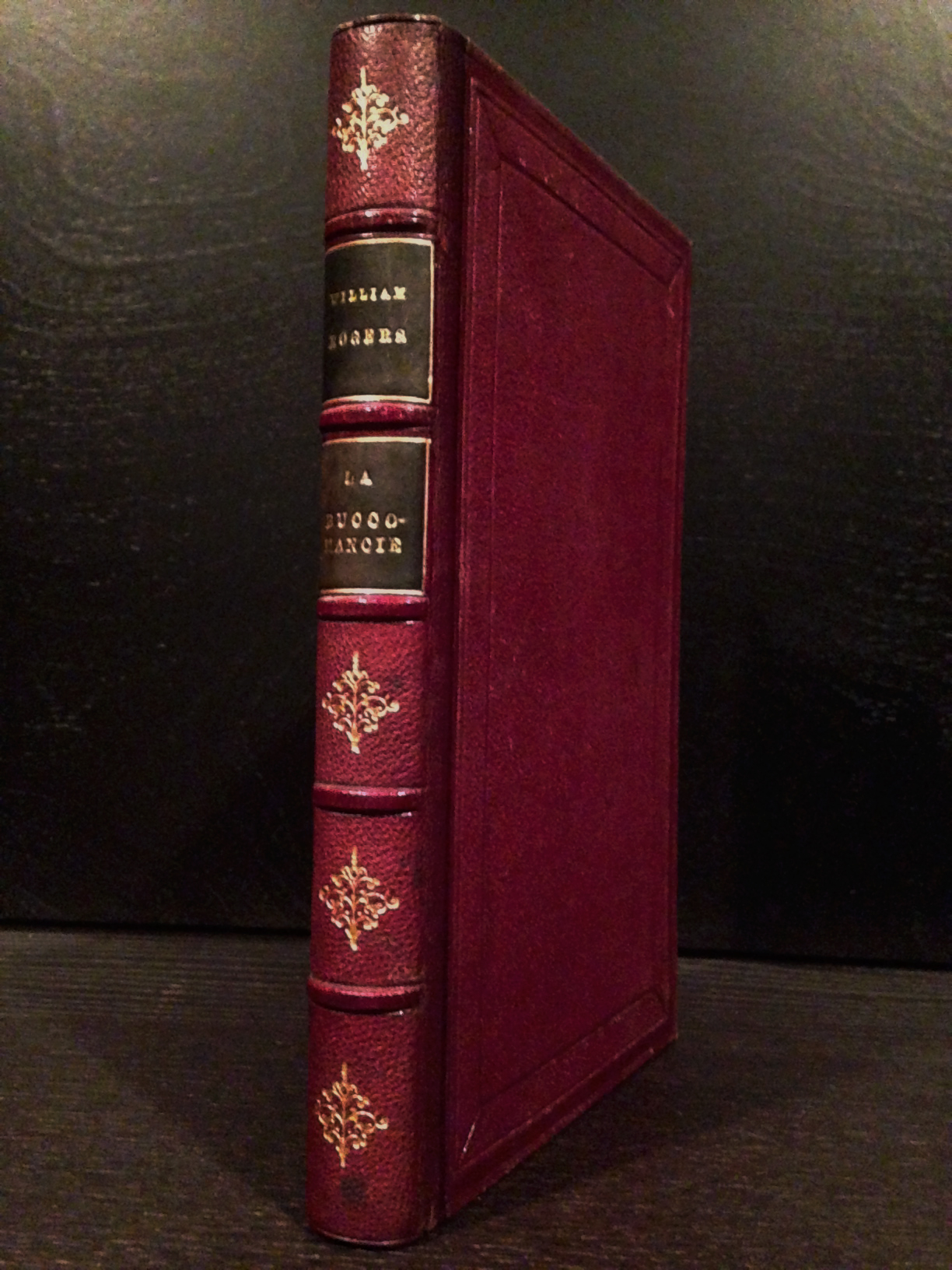
| Title: | La buccomancie; ou, L'art de connaitre le passe, le present et l'avenir d'une personne, d'apres l'inspection de sa bouche. Nouveau systeme buccognomonique, base sur la doctrine des plus celebres physiognomonistes, et principalmentsur la decouverte d'un alphabet buccal, c'est-a-dire sur les signes caracteristiques et revelateurs de la bouche humaine. |
| Publisher: | G. Bailliere |
| City: | Paris |
| Country: | France |
| Binding Detail: | contemporary burgundy sheepskin, blindtooling borders to boards, gilt to spine with raised bands, two green leather labels, marbled endpapers |
| Condition: | mild scuffing to boards, mild foxing throughout |
| Notes: | includes author portrait, and author's 11 page catalogue at end. Provenance: stamp "PERES DOMINICAINS POITIERS" on title page; Dominican Friars of Poitiers. From a Dutch Jewish family, Wolf Benjamin Cohen (1818-1852) adopted an anglicized pseudonym (William Rogers) to facilitate his business in posing as a London practitioner who graduated from the faculty of Edinburg (1818-1852) adopted an anglicized pseudonym (William Rogers) to facilitate his business in posing as a London practitioner who graduated from the faculty of Edinburgh, where he claimed to have been "received" in 1833. He also claimed to have invented amalgam and platinum dentures "osanores" as a dentist in Paris in 1836. Lacking any degree, he was sentenced in the first instance in December 1845, and appealed February 1846, for illegally practicing medicine following a complaint filed against him by Joseph Audibran and several other members of the Surgical Society dental Paris. This judgment was however reversed in May 1846. The Court of Cassation had ruled that the practice of dentistry is not akin to medicine if it did not extend to the treatment of diseases of the mouth. In the early 1850s, he tried to exploit the buccomancie, a variation of physiognomy designed to deduce character and personality from the teeth and the shape of the lips, mouth and chin. He published in 1851 a treaty of this pseudo-science, in which he said: "Show me a person's mouth and I'll tell you what he was, what he is, what he will be". |
| ⇐PREVIOUS | INDEX | NEXT⇒ |